
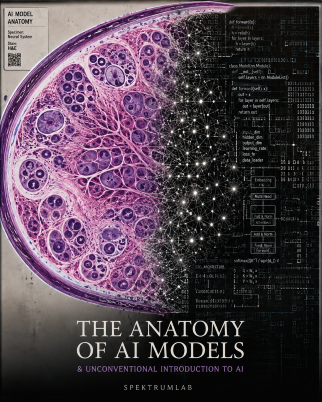
Learning to See What Isn’t There.
Long before I ever typed a prompt into an AI model, I spent years looking through a microscope at things nobody else in the room could see.
What I was studying and practicing for decades taught me how to make the invisible visible.
In pathology, a piece of tissue or a spread drop of blood looks like nothing much to the naked eye. Ordinary. Unremarkable. But section it, stain it, magnify it and interpret it correctly, and it tells you a story that was there all along, just invisible to anyone who did not know how to look.
That is one of the skills nobody tells you about in laboratory medicine. Similar in everyday life. Especially for people dealing with cutting-edge and emerging technologies.
A microscope does not hand you understanding, it is a tool. It hands you visibility, and visibility is only useful once you know what you are looking for.
I think about AI in a similar way now.
Everyone sees the output. Almost nobody sees the specimen.
Most people interact with AI the way they interact with a blood test result. I mean, they read the number at the bottom and move on.
Ask AI a question, receive an answer, done.
Fair enough, perhaps but not for me, mate. And hopefully not for many of you, my dear readers.
I hope you can see the connection I am drawing between my experience in pathology and emerging technology, particularly AI. In both fields, much of what truly matters remains hidden beneath the surface.
What is true, is true.
Most people also do not need to know how a hormone assay works to trust the number on their pathology report. We use incredibly complex technologies every day without understanding what happens underneath them. Cars, mobile networks, payment systems, medical diagnostics, and the Internet would become practically unusable if everyone were required to understand their internal engineering first.
AI is no different.
But for a smaller group of us, the number at the bottom is never the only interesting part.
The interesting part is everything sitting underneath it. I mean, the sample preparation, calibration, assumptions built into the method, sensitivity and specificity, interpretation, and the places where the process can quietly go wrong without anyone noticing.
AI works in a somewhat similar way, IMO.
The chat window is the result on the report.
The actual specimen (the thing worth dissecting) is the data the model was trained on, its architecture and algorithms, the objectives used during training, the incentives of the organisations and people who built it, the guardrails they chose to install, the compute constraints that shaped its development, and countless human judgement calls sitting underneath a system that appears, on the surface, simply to “know things.”
None of that is visible from a prompt box.
You have to go looking for it, the same way you must go looking for pathology under a lens.
My educated guess.
Statistically, I assume that at least the curious 5% are acting and thinking similarly to me. Exercising critical thinking and not taking life for granted.
There is another connection here that appeals to the statistician hiding somewhere inside me.
In a normal Gaussian distribution, approximately 95% of observations fall within two standard deviations of the mean. Extend it to three sigma, and you capture approximately 99.73%, leaving only around 0.27% in the two extreme tails.
I sometimes use this as a deliberately imperfect metaphor for people and curiosity.
Most people sit somewhere around the centre of the distribution. They use technology because it works. They do not necessarily care what powers the apparently magical technology behind their favourite AI-driven applications and devices.
That is normal behaviour. I do not mean “normal” as a judgement; I mean it statistically. It is how people close to the so-called “norms” often prefer to approach things: easy-going, with no unnecessary drama.
Then, there are people who keep moving away from the centre because they want to know what is underneath.
Why did it produce that answer?
What was the model trained on?
Why does another model answer differently?
What exactly is a model anyway?
Where does training stop and inference begin?
How much of what I am experiencing is the underlying model, and how much is an interface, system instruction, retrieval mechanism, or guardrail surrounding it?
And increasingly: when does the machine stop merely answering and start acting?
I was recently invited to speak at AgentCon Perth, where I had the honour of presenting my perspective on Modality – a phenomenon I first noticed, then continued to observe and describe in several papers. It remains an area I am very interested in exploring. It is a working theory.
If you are curious to learn more about what I discovered and why I continue working on it, please read my article. We can also talk about it I am always open to a thoughtful discussion.
Also, you do not have to live in the extreme tails of the distribution to ask these questions. Curiosity is enough.
And curiosity, fortunately, can be trained. So, can creative thinking and open-mindedness.
As I have said (and demonstrated on many occasions), it is never too late to change, mate.
Dissection, not demonstration.
That is the approach I want to take with this article and, probably more importantly, with the series that follows.
Not a demo.
Not a highlight reel of what the latest model can do.
A dissection.
What is the model actually made of? What data fed it, and what did that data include or leave out? What was it optimised to reward, and what did that reward quietly discourage? Where does the training end, and the guardrail begin, and who decided where that line should sit?
Finally, what Modality may or may not to be.
Then there is the physical anatomy that most users never see.
AI does not exist somewhere in an abstract “cloud.” Behind the interface are chips, memory, networks, data centres, electricity, cooling, engineering and increasingly enormous amounts of capital. Compute is becoming infrastructure at a scale where technology starts intersecting with energy policy, geography and geopolitics.
This is where looking at individual components becomes insufficient.
Data influences models. Models determine compute requirements. Compute depends on chips, energy and physical infrastructure. Infrastructure depends on capital and politics.
Models are wrapped in interfaces and guardrails. Humans (at least by now, and I wish it stays this way) determine objectives and constraints. Those systems then return to influence human decisions, businesses, labour markets, and eventually the infrastructure that gets built next.
The anatomy is becoming a living system.
That is why I think understanding AI only as software is becoming increasingly misleading and certainly not enough for the modern time we are living.
The brain behind the code.
Neural networks are routinely compared with the human brain. The comparison is useful up to a point, but it can also create the illusion that we understand more than we do.
Artificial neurons are mathematical constructs, not tiny digital versions of biological neurons.
Still, the analogy helps us understand one important idea: complex behaviour can emerge from enormous numbers of relatively simple operations interacting with each other.
A modern AI model learns statistical relationships and patterns from enormous quantities of data. During training, parameters inside the model are adjusted repeatedly as the system learns to produce outputs that better satisfy its training objective.
What emerges is not a conventional database containing a neat library of answers.
This distinction is important.
When we interact with a generative AI system, it is generating an output from patterns represented within the model. That is one reason these systems can produce something remarkably insightful in one moment and something confidently wrong in the next.
From a pathology perspective, I find this particularly interesting because it brings us back to interpretation.
The instrument produces something.
The human still needs to understand what that something means. It is sort of the Good Laboratory Practice combined with a current Human-in-the-loop.
A trained eye is a learnable thing.
Here is the part I actually believe, not just as an analogy but as something I have lived.
The ability to see structure underneath a smooth surface is not a gift. It is trained.
Pathologists spend years building pattern recognition most people will never develop, not because they were born with sharper eyes, but because they were taught what to look for and then made themselves look, repeatedly, until recognition became almost automatic.
I think the same discipline applies to AI literacy.
You do not need a computer science degree to develop a trained eye for how these systems behave, where they are strong and where they are quietly guessing.
You need enough knowledge to understand the basic anatomy. You need curiosity about what sits underneath the output. And you need enough repeated exposure for pattern recognition to begin working.
The objective is not for everyone to become an AI engineer, just as understanding a pathology report does not require becoming a pathologist.
The objective is to stop confusing a polished interface with the system underneath it.
AI did not suddenly arrive.
There is another reason I want to dissect AI rather than simply describe the current excitement around it.
AI is not a new concept.
One of the early systems that fascinated me when I started looking into AI history was ELIZA, created at MIT in the 1960s. There is a personal coincidence I cannot resist: that work began around the same period I was born.
That perspective matters.
What we are experiencing today did not appear from nowhere with ChatGPT. Decades of work in computer science, statistics, machine learning, neural networks, hardware, data infrastructure and networking accumulated until different pieces began reinforcing one another.
The result feels sudden because we experience technological change at the interface.
Underneath, the specimen has been developing for decades.
And now something else is changing.
For years, most AI systems waited for us. We provided hardware, we provided an input; the machine generated an output. Human in the loop.
Increasingly, we are seeing agentic systems capable of planning multiple steps, using tools, maintaining context, and executing actions with progressively less human intervention. Just to mention Open Claw or Hermes Agent.
The transition is subtle but fundamental.
We are moving from machines that answer toward machines that can act.
This is only the first section.
Dear reader, consider this article the opening incision rather than the completed anatomy.
The Anatomy of AI will continue, hopefully as a series.
In the pieces that follow, I may dissect the layers individually.
Then reconnect them to understand the system they are collectively creating.
Because looking at the organs independently is not enough.
Eventually we need to understand the organism.
My final thoughts.
And somewhere further down this road sits another question that interests me enormously: Day “0.”
Today AI is still operating, in many environments, at what I would call half throttle – constrained by humans in the loop, permissions, guardrails, and deliberately limited autonomy.
At the same time, agentic systems are beginning to operate with considerably less direct human intervention, or even “no-human-in-the-loop”.
Where exactly that trajectory leads, and whether there is ever a meaningful Day “0” separating one era from another, I do not pretend to know.
We can model it. We can speculate. We can prepare.
Perhaps we can even pray. Why not?
But first we should understand the anatomy of the thing we are increasingly trusting to think (and act) alongside us.
That requires learning to see what isn’t there.
And that is where I want to begin.