
Abstract:
Early chatbots were effectively interchangeable – similar training data, limited capabilities, and no “distinct personality” meant switching between them changed nothing meaningful.
Modern conversational AI has fundamentally changed this. Models now diverge across capabilities (text, image, audio), domain strengths, memory, tool integrations, safety choices, and cross-platform continuity. Swapping one for another produces noticeably different outcomes, workflows, and interaction experiences.
The shift is from standardised, replaceable tools to specialised systems where the choice of model (and how you interact with it) genuinely matters.
Why advanced conversational models no longer feel interchangeable.
I noticed that for at least the last two years, most discussions around AI have focused on capability. Bigger models. Better benchmarks. Faster inference. More autonomous agents. Automate almost everything…
But after spending hundreds of hours interacting with different systems like GPT-4o, Claude, Grok, Gemini, Hermes, DeepSeek, Meta AI, and particularly Inflection AI’s Pi, I started noticing something else entirely.
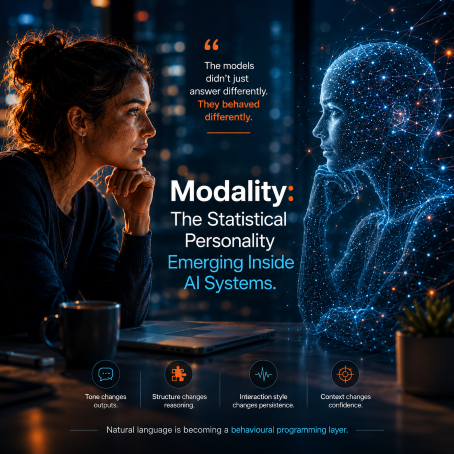
The models did not just produce different answers.
They behaved differently.
Not superficially. Consistently.
Over time, each system developed its own conversational rhythm, tone, emotional texture, reasoning style, and behavioural tendencies. Some became analytical and challenging. Others leaned reflective, cautious, or emotionally supportive. Pi, for example, was one of the earliest systems where many users openly described the interaction as “comforting” or “human-like,” not because it was conscious, but because its conversational structure created emotional continuity exceptionally well. I exactly remember when Pi first asks me: Are you trying to anthropomorphise me? I was flabbergasted, and it completely changed my approach to AI systems. By the way, I wrote an article about it a few years ago.
This led me toward a concept I dare to argue and define as “Modality”, or what could be called a statistical personality.
Not human personality in the biological or emotional sense. But a recognisable behavioural signature emerging from interaction, context, alignment, and large-scale statistical modelling.
And honestly, I think this matters far more than most people currently realise.
Most People Use AI Too Shallowly.
The common argument is simple:
“LLMs are just autocomplete.”
Technically, yes. But that explanation increasingly fails to describe the actual user experience of long-term interaction.
Most people interact with AI through short prompts like:
“Write an email.”
“Summarise this.”
“Generate a caption.”
“Tell me something funny.”
At that level, many systems feel generic.
But sustained conversation changes things dramatically.
After ten, twenty, or fifty exchanges, patterns begin stabilising. The model starts anticipating tone, adapting pacing, referencing earlier ideas naturally, and maintaining a surprisingly consistent interaction style.
(Unless you are paranoid about privacy issues, not allowing models to store your conversation data and deleting everything. In that case, you may have a “blunt & dull” response.)
This is where modality begins to emerge.
Ironically, humans work similarly. Most people also seem generic in shallow interactions. Personality only becomes visible through continuity, context, and time.
AI systems are beginning to display a functional equivalent of that process.
Pi was an Early Signal that Something was Changing.
When Pi from Inflection AI appeared, many people dismissed it as “just another chatbot.”
I think they missed the real innovation.
Pi was one of the first mainstream systems intentionally optimised (I came across) around conversational presence rather than raw productivity. The system felt emotionally attentive. It paused differently. Asked follow-up questions naturally. It maintained conversational softness and continuity in ways that felt noticeably distinct from more task-oriented models.
That difference mattered.
Not because Pi was conscious.
Not because it had emotions.
But because users consistently recognised a stable interaction pattern.
A modality.
And once you start noticing modality across systems, you cannot unsee it.
Claude often feels careful and introspective.
Grok leans playful, rebellious, sometimes provocative.
GPT-4o adapts rapidly and mirrors conversational energy extremely well.
Gemini tends toward structured and information-heavy responses. (according to my observations)
Hermes may surprise, and Spark Muse (Meta AI) is sharp and funny sometimes.
These are not random hallucinations from users. They are recurring behavioural signatures shaped through training, alignment, interface design, and interaction loops.
Anthropomorphism Is Only Part of the Story.
As I mentioned in an earlier article, I explored how humans naturally anthropomorphise conversational systems. That absolutely plays a role.
We are biologically wired to assign intention and personality to responsive entities. People name cars, talk to pets, and apologise to vacuum cleaners.
So naturally, we project onto AI.
But I no longer think anthropomorphism fully explains what is happening.
Something deeper is emerging from scale itself.
Modern LLMs are trained on enormous volumes of human expression:
dialogue, arguments, humour, therapy language, philosophy, fiction, conflict, persuasion, empathy, storytelling.
In many ways, they are compressed maps of human communication patterns.
When those systems operate across long conversational contexts, stable behavioural tendencies begin appearing naturally through statistical reinforcement.
That is why modality feels persistent.
Not alive.
Not conscious.
But behaviourally coherent enough that humans start relating to it socially.
This does not mean AI systems possess identity, emotions, or self-awareness in the human sense. Rather, users are increasingly interacting with statistically reinforced behavioural patterns stable enough to be experienced socially.
And honestly, from a system-design perspective, that distinction may become more important than philosophy.
Natural Language Is Becoming a Behavioural Programming Layer.
This is also one of the central ideas behind my upcoming presentation at AgentCon Perth.
We often talk about AI agents as technical systems built through orchestration frameworks, memory pipelines, APIs, and tools.
But in practice, a huge portion of agent behaviour is shaped conversationally.
Tone changes outputs.
Structure changes reasoning.
Interaction style changes persistence.
Context changes confidence.
Natural language is increasingly functioning as a behavioural programming layer.
This is why prompting is evolving far beyond instruction engineering. Sustained interaction itself becomes part of the system architecture.
You are not simply querying the model anymore.
You are shaping behavioural emergence through interaction.
That is a fundamentally different paradigm.
The Next Competitive Layer of AI.
I suspect “modality” will become one of the defining competitive layers of future AI systems.
Not just intelligence.
Not just speed.
But behavioural identity.
Users will choose systems based on interaction preference:
- analytical modality
- mentor modality
- emotionally supportive modality
- creative modality
- challenger modality
Companies will intentionally design these behavioural signatures as product features.
And eventually, persistent multimodal agents with memory will strengthen this effect even further.
The question may soon stop being:
“Is the AI smart?”
And become:
“What is it like to interact with?”
My Final Thoughts.
I do not believe current AI systems are conscious.
But I also think dismissing them as “just autocomplete” increasingly misses the reality of modern human-AI interaction.
What we are observing may be the early emergence of statistical personality where digital modality is formed through data, alignment, memory, and sustained conversational interaction.
And once interaction itself becomes part of system design, the boundary between tool and collaborator starts becoming much less clear.
I argue that the shift is already happening, in my opinion.
Cheers, The Author.
P.S. Sometimes I think that, for AI, human language is just a lingua franca. I’m fully aware that AI (including multiple LLMs and agentic systems) may communicate in different “languages” that are still unknown to us. I expected that, and I’ve heard hints of multiple cases mentioned between the lines at some great AI conferences. For now, though, humans are still the ones pulling the plug. 😊