
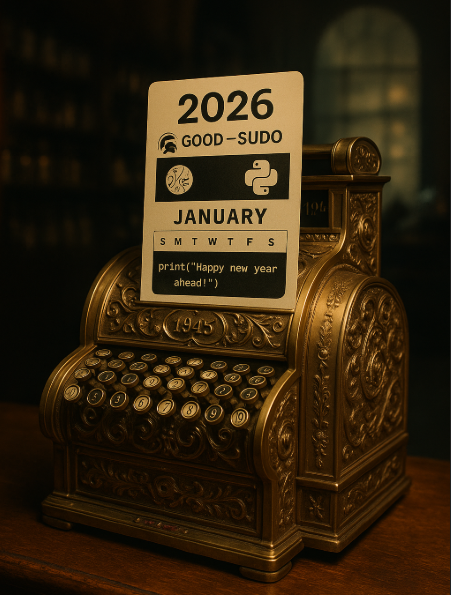
Looking for the unknown or unsure about the future?
Not sure what is going on, or what may happen? You are not alone. Honestly, I am not sure either. A couple of years ago, things felt more obvious. Today? Not so much, at least not for me.
It’s now the fifth year I’ve been writing and publishing on spektrumlab.io – a space I founded to explore the intersection of emerging tech, strategy, and digital transformation. I’m Jacek Korneluk, and this year feels different.
But it’s also the first year I’ve hit hesitation and friction. Until now, most of what I was writing about felt glaringly obvious, even my near-future predictions had a certain clarity to them.
But sometime around mid-2025, I started noticing a shift. The clarity I used to have in how I researched, processed, and understood information started to blur. Even the daily stream of emails I receive, which used to bring clear insights, began to feel… off. Less useful. Or maybe just harder to decode.
Was it just information overload? Or are we simply producing more digital rubbish than ever?
I struggled to read through 2,000-word PDFs without drifting off or reaching for AI to summarize them for me. I’d had these thoughts before, so part of me expected this shift. But this time it hit harder. The flow and quality of information changed drastically. It completely disrupted my previous way of working.
I realised two things. First, something is different. Not wrong, necessarily, just different. Second, I needed to change too. Slow down, zoom out, and start looking at things through a different lens.
My flat, linear approach wasn’t cutting it anymore. You can’t solve a problem without first truly understanding it. That much, at least, I’m sure of.
So, I put my background in clinical diagnostics, analytical thinking, and technical and political awareness to use and started digging. What came out of that process is this piece, both a proof of concept and a personal summary of my predictive take on what’s unfolding.
We’ve reached a point where we need to adjust everything, especially in how we operate online and use disruptive technologies. It’s no longer as simple or obvious as it once was. Not in AI, not in blockchain, not in geopolitics. At least not from my view.
Some truths are more visible. Others are buried, hidden beneath piles of digital noise, real-world tragedy, or even literal brick-and-mortar rubble.
Either way, life is changing, stealthily and quietly. Whether we like it or not, it’s happening.
If you want to track the shift, you’ve got to look for indicators, subtle signs that something’s different. I won’t dive into political changes here, not today. As a Blockchain and AI strategist, my focus is on tech, the tools, the platforms, the online layers that shape how we live.
That said, I can’t ignore the link. Geopolitics and emerging technologies are deeply connected and increasingly co-dependent. It’s like using a microscope. What you see depends on your resolution and the filters you apply. Your method shapes your outcome. And if your view is too broad or too messy, you mostly end up with garbage.
That’s why specificity matters. Just like in diagnostics, narrow your focus, isolate the signal, then build the bigger picture from those smaller, precise insights. Like LEGO bricks. Or puzzle pieces.
Ok, final thoughts to kick off 2026 on spektrumlab.io:
We’re living in the time of MAS (Multi-Agent Systems) and latent collaborations between different LLM models (Jiaru Zou et al., 2025). Natural language alone isn’t enough anymore, not if you want to solve truly complex problems. We’re entering the phase of latency vectors, where AI agents don’t just talk, they think together.
Latent collaboration is basically when multiple AI models (agents) skip the small talk. Instead of exchanging long chains of text like we humans do, they share their internal “thoughts” directly in the form of latent vectors. These are high-dimensional data points living in what we call latent space. Think of it as a kind of shared mind map or memory where ideas are richer, more precise, and way faster to pass around. This isn’t just theoretical fluff. Frameworks like LatentMAS already show that this way of “talking without words” actually makes multi-agent systems smarter, quicker, and cheaper to run, especially when it comes to stuff like reasoning, math, or code. It’s like LLMs working together telepathically, no noise, just raw ideas firing across the network (Jiaru Zou et al., 2025).
So, what now? Where do we go from here?
I still wonder about the idea of AGI. Sometimes I even feel like I’m losing interest in it. Not because it’s not important, but because the path forward feels more fragmented, less linear. Like a puzzle that keeps expanding with every new piece.
But here’s the truth. We’re all part of this, whether we choose to engage directly or not. I’m genuinely curious what the next LEGO bricks will look like and how the picture will come together in the end.
To see it clearly and hear the full story, you’ve got to stay awake. Stay sharp. Stay curious. And yes, being technically native helps.
The rest? That’s our near and coming future. One we’re all building, often without even realising it.
Happy and better 2026 to all of you, dear followers and readers.
Let the power of disruptive technologies and the force of emerging systems be with you.
Cheers,
Jacek Korneluk