
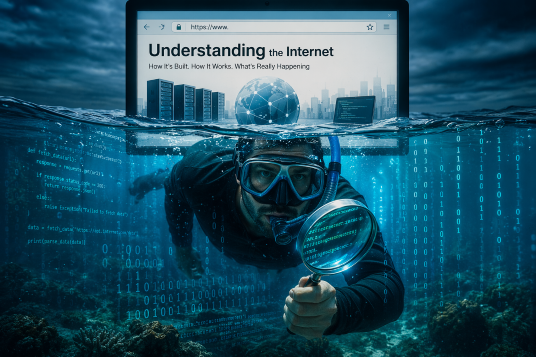
Introduction: Where Curiosity Actually Begins.
“From URL to Reality & The Hidden Journey of Your Data”
My first serious contact with networking came through a YouTube presentation called “Networking Fundamentals – From Zero to HTTP” by a mysteriously named guy, TomNomNom (Tom Hudson). It was exactly what I had been looking for: a combination of slides, explanations, and real-world walkthroughs that took you from absolute basics all the way to understanding how an HTTP request actually travels through the stack – MAC, ARP, IP, TCP, DNS, and beyond.
At the beginning, it felt a bit challenging, but very quickly it became something else entirely interesting, even addictive. That one talk opened the door. From there, I started exploring more publications, signed up for a few good courses, and gradually expanded into areas like cybersecurity & elements of privilege escalation, just to understand how systems behave under stress or attack.
At the same time, I began learning Python as a complete beginner. Yes, in my fifties – better late than never. What started as curiosity slowly turned into a deeper pursuit. I mean, understanding how two machines communicate, what a network interface really is, how ports and handshakes work, and why protocols even exist.
This led me into Linux environments – first Mint, then Ubuntu, and eventually some controlled exposure to Kali Linux during a cybersecurity course and in virtual lab setups. I explored both the OSI 7-layer model and the simpler Internet Protocol Suite, trying to visualise how these structures operate in practice.
Coming from a background in biochemistry and molecular sciences, imagining invisible systems was nothing new to me. I simply applied the same mindset to networking. Instead of molecules, I started seeing packets, flows, and interactions. Terms like TCP, TLS, and IP stopped being abstract acronyms and became understandable processes.
Tools like Wireshark made this even more tangible, allowing me to observe network traffic directly. The “invisible” part of the internet began to reveal itself. Discovering VPNs added another layer of understanding around privacy and routing, and joining communities like the Perth Linux Users Group (PLUG) helped me learn from experienced practitioners. I even served as a PLUG Committee Member for some time doing my best to make my contribution and impact.
Now, when you combine networking knowledge with blockchain, Web3, and AI, things can become overwhelming at times. But connecting these pieces together leads to something valuable: clarity. You begin to understand not just what you are doing online, but what is actually happening beneath the surface..
And once you see it, it is very difficult to go back to being just a passive user.
What We Should Actually Be Aware Of.
We do not need to become engineers or experts in every domain. However, having a basic awareness of a few key areas can significantly change how we interact with the digital world. Concepts such as networking fundamentals, protocols, servers, infrastructure, and privacy are no longer niche knowledge. They form the foundation of modern digital life.
Even a surface-level understanding of these elements provides an advantage. It allows users to move from blind interaction toward informed participation. The internet may appear simple on the surface, but underneath it operates as a structured and rule-based system.
A good example of this is TCP – the Transmission Control Protocol. TCP ensures that data is delivered reliably and in the correct order between devices. Before any meaningful communication happens, a connection is established through a process known as the three-way handshake (SYN, SYN-ACK, ACK). This guarantees that both sides are ready to exchange data. It also manages retransmissions, ordering, and flow control, ensuring stability even in complex network conditions.
This is just one layer among many, yet it already demonstrates how much coordination is required behind the scenes.
You Type a URL… Then What?
From a user’s perspective, the process feels trivial. You open a browser, type a website address, press enter, and the page loads almost instantly. However, beneath this simple interaction lies a complex chain of events that unfolds in milliseconds.
This is not magic – it is called an infrastructure.
The moment you enter a URL, your device must first determine where that website actually exists. Since traditional computers do not understand human-readable names like “google.com,” a system called the Domain Name System (DNS) translates that name into an IP address. This process functions much like a global phonebook, mapping names to numerical identifiers.
However, this model is already beginning to evolve. With AI agents increasingly operating on user devices and within applications, parts of this process are becoming more dynamic, abstracted, and in some cases even predictive. Instead of simply resolving names, intelligent systems may anticipate requests, pre-fetch data, or interact with services on behalf of the user. The underlying infrastructure remains the same, but the way we access and interact with it is starting to shift.
Once the IP address is obtained, your request begins its journey across the network. Instead of traveling as a single unit, the data is broken into smaller pieces known as packets. Each packet carries part of the information along with addressing details, allowing it to navigate independently through routers, service providers, and intermediate nodes.
These packets may take different paths to reach their destination, but they are reassembled correctly upon arrival. This distributed approach makes the internet highly resilient, as data can reroute around failures or congestion.
To maintain order in this seemingly chaotic system, protocols define strict rules for communication. The Internet Protocol (IP) handles addressing and routing, TCP ensures reliable delivery, and HTTP or HTTPS governs how web data is requested and delivered. HTTPS adds an additional layer of encryption, protecting data as it travels across networks.
Eventually, the request reaches a server – a computer designed to store and provide data. The server processes the request and sends back a response containing the components of a webpage: HTML for structure, CSS for layout, JavaScript for interactivity, and various media files. These elements are again transmitted as packets, reassembled by your browser, and rendered into the final page you see.
The Layers We Don’t See.
What appears on the screen represents only the front-end of the system. The visual interface is designed for user interaction (UI or GUI). Behind it lies the back-end, where the real processing occurs. Databases store information, servers execute logic, and APIs connect different services together.
Additionally, the path between the user and the server is rarely direct. Routers manage traffic across networks, proxies can filter or redirect requests, and content delivery networks (CDNs) store cached versions of data closer to users to improve performance. These intermediate layers play a crucial role in optimizing speed, efficiency, and reliability across the internet.
For those who are particularly curious and open to exploring more advanced concepts, networks such as Tor (The Onion Router) offer an alternative way of routing traffic through multiple layers of encryption and relays. However, this approach is not generally recommended for beginners, as it introduces additional complexity and requires a better understanding of privacy, security, and potential risks. Still, being aware of its existence adds another layer to understanding how diverse and flexible internet infrastructure can be.
Another critical component is the Internet Service Provider (ISP), which acts as the gateway between users and the wider internet. Every request typically passes through this provider, which means it has visibility into certain aspects of user activity. This is one reason why technologies such as VPNs are used. They alter the routing of traffic and introduce additional layers of privacy, although they do not provide complete anonymity.
Even basic activities such as sending an email or a message involve multiple systems. Data is routed through servers, temporarily stored, and then retrieved by the recipient. Direct communication in the digital world almost always involves intermediaries.
Why This Perspective Matters.
Understanding this process fundamentally changes how we perceive the internet. It is no longer a single entity but a network of interconnected systems working together. Every action becomes a sequence of requests and responses, governed by protocols and supported by infrastructure.
This awareness leads to better questions and more informed decisions. Users begin to consider where their data travels, who controls the systems they rely on, and what risks may exist within those layers.
This shift in perspective aligns directly with the broader transformation discussed in the first article. As the internet evolves into a financial, informational, and increasingly intelligent infrastructure, passive usage becomes less viable.
From Infrastructure to Ownership and Intelligence.
The system described so far largely reflects the traditional, centralised internet, where platforms and service providers act as intermediaries. However, this model is evolving.
Blockchain technologies introduce the concept of direct ownership, allowing users to control assets without relying on centralized institutions. Web3 expands on this idea, shifting certain aspects of control from platforms to individuals. At the same time, artificial intelligence adds a new dimension – systems that not only transmit data but also interpret, generate, and influence it.
These developments build on the same foundational infrastructure but alter the dynamics of participation. The user is no longer just interacting with interfaces but increasingly engaging with systems that carry elements of autonomy and decision-making.
Closing Thoughts.
The internet may feel instantaneous and effortless, but behind every interaction lies a structured, multi-layered process that connects devices across the globe. While mastering these systems is not necessary, developing a basic understanding of how they operate can significantly enhance digital awareness.
This knowledge transforms the user experience. Instead of interacting blindly, individuals begin to recognise patterns, identify risks, and make more informed decisions. In a rapidly evolving digital landscape shaped by AI, blockchain, and decentralised systems, this awareness becomes increasingly valuable.
Understanding the journey of data is only the first step. The next step is understanding control – who holds it, how it is exercised, and how it may shift in the future.
And that is where the conversation becomes even more interesting.
Finally, “Trust and Control” are important, as some key people mentioned on several occasions.
However, only informed decisions truly make sense and matter. Without clear information, transparency, and understanding, trust is difficult to build, and control is difficult to justify.