
The Shift in Modern Gaming.
Gaming is changing.
Not just in graphics or scale, but in what players expect from the time they invest in digital worlds.
For years, players have spent hundreds, sometimes thousands, of hours building characters, unlocking items, and progressing through expansive experiences. Yet despite that investment, the outcome has remained largely the same: everything is temporary.
Characters are left behind. Progress resets. Worlds disappear.
At its core, gaming is still about immersion, creativity, and enjoyment. Players are not asking for games to become financial systems, nor are they demanding constant monetary reward.
But there is a growing expectation that time spent in a game should mean something.
Modern players are beginning to look for:
- Progress that persists beyond a single title
- Worlds that feel alive and reactive
- Systems that respect the time they invest
- Experiences that extend beyond isolated sessions
This shift isn’t about replacing traditional gaming – it’s about evolving it.
Web3 Gaming and the New Opportunity.
This is where Web3 gaming enters the conversation.
Not as a trend, but as a response to changing player expectations.
Web3 technologies, when applied correctly, allow developers to rethink how games are structured. They create the possibility for systems where progression, identity, and participation carry weight beyond a single experience.
This doesn’t mean forcing blockchain into gameplay. In fact, the opposite is true.
The opportunity lies in designing games that are immersive and enjoyable first, while using emerging technologies to support that experience in the background.
When approached this way, Web3 enables:
- Persistent player identity across evolving worlds
- Ownership of digital elements that outlive a single game
- Community-driven systems that feel organic rather than imposed
- A sense of continuity in an industry traditionally defined by resets
The goal is not to extract value from players.
It is to create environments where value (whether emotional, social, or experiential), naturally forms.
The Misunderstood Narrative.
Despite this potential, both blockchain and artificial intelligence have developed a complicated reputation within gaming communities.
Blockchain is often associated with speculative projects, low-effort asset drops, and systems designed more for monetization than gameplay. AI, particularly in creative fields, is frequently viewed as a shortcut – something that replaces rather than enhances human work.
These perceptions didn’t appear without reason.
In many early implementations, the technology was positioned as the product. Blockchain became the selling point. AI became a replacement tool.
The result was predictable:
- Experiences built around extraction instead of engagement
- Systems that prioritised monetization over immersion
- Content that lacked intention and authenticity
But these outcomes are not inherent to the technologies themselves. They are a reflection of how they have been used.
The principle is simple:
Technology should never be the focus.
The game and experience must always be the foundation.
Today, these tools are more accessible than ever. Over the past decade, blockchain and Web3 have shifted from niche concepts to widely recognised technologies. With that shift comes responsibility.
The conversation is no longer about whether these systems can be used in gaming.
It is about how they should be used.
What Blockchain Actually Enables.
At its core, blockchain is a system for recording data in a way that is permanent, verifiable, and independent of a single controlling entity.
In gaming, this introduces something that has never truly existed before:
Persistence at a foundational level.
Instead of player data being locked within a single game or server, certain elements – such as identity, progression, or ownership – can exist beyond the lifecycle of one experience.
This allows for:
- Data that is secure and verifiable
- Progression that can persist over time
- Systems that are not entirely dependent on one developer or platform
More importantly, this data is programmable.
Developers can design systems where recorded data influences gameplay in meaningful ways:
- Past achievements shaping future opportunities
- Ownership affecting in-game interactions
- Reputation influencing how the world responds to a player
Blockchain is not about turning every in-game item into a tradable asset.
It is about creating a reliable layer of truth that games can build upon – one that supports continuity rather than constant reset.
AI in Gaming: From Static to Living Worlds.
Alongside blockchain, artificial intelligence is beginning to redefine how game world’s function.
Traditional NPCs have always been limited. They operate on predefined scripts, repeat dialogue, and follow predictable patterns. While effective, this creates boundaries for immersion.
Players learn how systems work, rather than engaging with something that feels alive.
AI introduces a different possibility.
It allows developers to create characters that:
- Respond dynamically to player actions
- Adapt based on past interactions
- Retain memory and context
- Evolve over time
Instead of static encounters, players experience relationships that develop.
NPCs shift from being scripted elements to active participants within the world.
At the same time, it’s important to recognise that AI is not a replacement for human creativity. In areas like art and storytelling, audiences still value authenticity, intention, and the human touch.
AI’s role is not to replace that – it is to enhance it.
When used correctly, it allows designers and writers to push beyond technical limitations and create deeper, more responsive experiences.
We’re already beginning to see early implementations of this approach, with projects experimenting with AI-driven characters that respond, remember, and evolve over time – shifting NPCs from static systems into living participants within the world, as seen in emerging experiences like the Farlands.
From Assets to Identity.
While ownership is often the focus of blockchain discussions, the more meaningful shift lies in identity.
For the first time, there is an opportunity to move beyond disposable characters and create persistent player identities that evolve over time.
Imagine a system where your character is not confined to a single game, but represents an ongoing journey:
- Achievements that carry forward
- A reputation that has meaning across experiences
- Progression that builds over years, not sessions
This changes how players engage with games at a fundamental level.
Instead of starting from zero each time, players continue their story.
This shift, from temporary progress to persistent identity, is where the long-term impact becomes clear.
In our own development, persistent identity is not treated as a feature, but as a foundational layer: something that exists beneath the experience itself, allowing player history, progression, and reputation to carry forward rather than reset.
Designing for Players, Not Systems.
For these technologies to succeed, the focus must remain on the player.
A game should always be fully enjoyable on its own – without requiring any understanding of blockchain, wallets, or underlying systems.
These technologies should act as enhancements, not barriers.
When implemented correctly:
- Players who want a traditional experience can have one
- Players who engage more deeply can access additional layers
- The world feels richer without becoming more complex
The best implementations are often invisible.
Players don’t think about the technology, they feel the result. The enjoyment of the story, environment, and overall experience.
Balancing Economies and Experience
One of the most challenging aspects of Web3 gaming is economic design.
Closed systems provide stability and control. Open systems introduce liquidity, trading, and external participation.
Both approaches have value.
The key is ensuring that economies support the experience, rather than define it.
Games should:
- Reward engagement without exploiting it
- Encourage participation without requiring financial input
- Align with long-term design goals rather than short-term demand
Sustainable systems are those where players choose to participate – not because they feel pressured to, but because the experience itself is compelling.
Interoperability and Continuity.
Interoperability is often framed as the ability to move assets freely between games, but its true value lies in continuity.
Rather than forcing compatibility between vastly different systems, the focus should be on shared layers:
- Identity that persists across experiences
- Progression that informs future gameplay
- Systems that allow worlds to connect without losing their uniqueness
It is less about transferring assets and more about maintaining a consistent player journey.
Looking Forward.
We are still in the early stages of this transition.
The technology is evolving. The tools are improving. The understanding of how to apply them is becoming clearer.
What is certain is this:
- The future of gaming will not be defined by technology alone.
- It will be defined by how effectively that technology serves the player.
- Blockchain and AI offer powerful tools – but only when used with intention.
The next generation of games will not succeed because they include these systems.
They will succeed because they create worlds that players want to stay in.
And in those worlds, time will finally matter.
Kind Regards, Jaizel Macphail
About the Author:
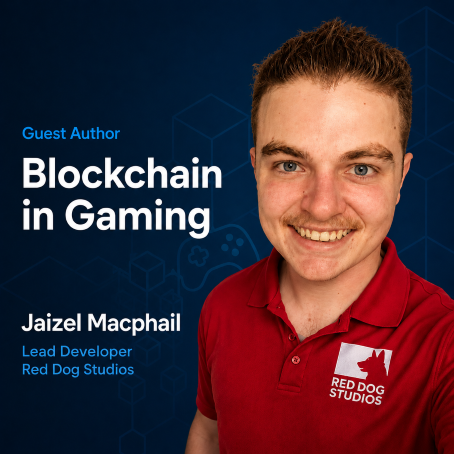
Jaizel Macphail is the Founder and Lead Developer of the Farlands, an MMORPG exploring persistent player identity, AI-driven NPCs, and blockchain-supported systems. His work focuses on building immersive, player-first experiences where technology enhances, but does not define, the gaming experience.
“The blockchain is a tool to enhance your journey, not define it.”
https://www.reddogstudios.com.au/
You may contact the author at: https://www.linkedin.com/in/jaizeljay